Looked at Facebook when I woke up yesterday morning and saw a photo of an ibis posted by Parker River National Wildlife Refuge. I didn't click on it to see it full size. The caption didn't say anything about species, so I assumed it was just a normal glossy ibis. Besides that, I was already on a mission for the day, having received email from Istvan that he hadn't received the Mac G4 power supply I sent him. The numbers I was typing in to the postal service web site kept getting errors, so I went to the post office and got info from them on how to trace international packages. Finally tracked it down -- it's still in Hungarian customs. So much for the cloud solving everything. Sometimes you need to get a piece of hardware from point A to point B through customs. Anyway, by the time I was done with the power supply mission, it was mid-afternoon. For some reason I was looking at Facebook again and clicked on the ibis picture. At full size, I could see that it was a white-faced ibis.
I threw camera and binoculars in the car and drove up to the refuge. Sure enough, there was a white-faced ibis at the north end of the salt pannes. It had attracted a fair number of birders. I watched it for a long time. It was quite active, catching fish and what looked like a crab. It really seemed to be eating up a storm. I kept hoping it would come closer to the road so I could get a decent picture -- the blogosphere has high standards for photos nowadays.
 |
| White-faced Ibis |
The first round of birders left. A couple of women from New Hampshire arrived. They too were wishing it would come closer for a photo op. They asked if I'd seen a white-faced ibis on the refuge before. Yup, I'd seen one in 2007 with a flock of glossy ibis.
I was wishing for a really long lens or a digiscoping setup because there were multiple photo opportunities in the vicinity of the ibis. A greater and a lesser yellowlegs were foraging near each other for convenient size comparison. A killdeer was posing with its reflection in the water. (If you view the ibis photo full size you might be able to pick out the killdeer.)
 |
Wild Turkey
|
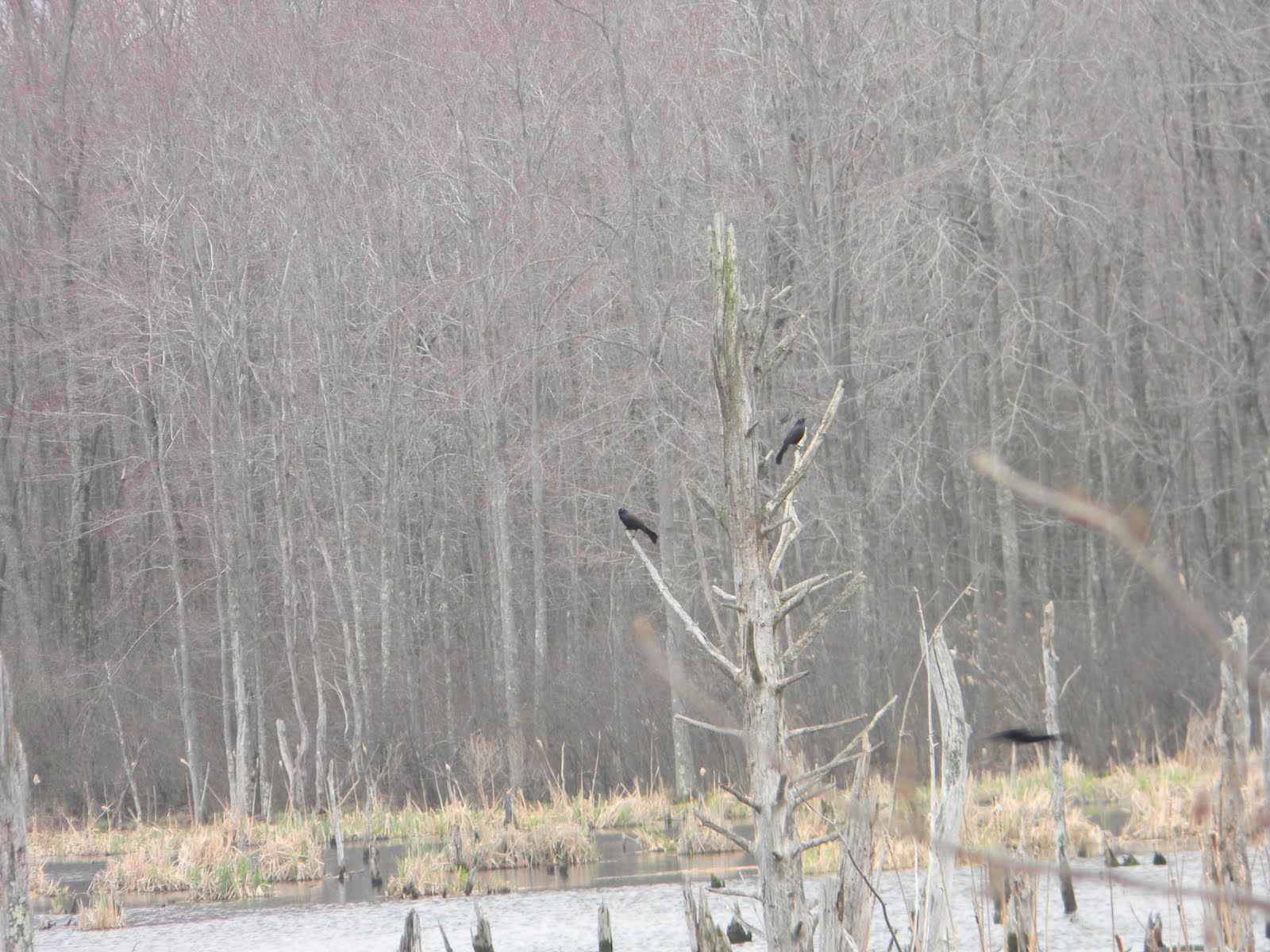
Continuing south, I encountered redwinged blackbirds, double crested cormorants, and tons of American robins. At the Pines Trail, I saw my first two northern flickers of the season. They were foraging on the ground surrounded by American robins, common grackles, American robins, and a northern mockingbird. I looked up towards the osprey platform and spotted a lone wild turkey on the dike.
 |
| Eastern Coyote |
I parked at lot 5 and walked the boardwalk to platform that overlooks the beach. On the way, I spotted an eastern coyote. Said coyote spotted me too. I could see it watching me.
From the platform, I saw a big flock of funky looking long-tailed ducks diving in the surf and a line of 50 migrating double crested cormorants. I stared out over the Atlantic Ocean until I was thoroughly cold and windburned. On the way back to the gate, I saw a great egret and some more yellowlegs.
 |
| Great Egret |
 |
| Yellowlegs |